The Man Who Laughs on DVD:
a review by David Gasten
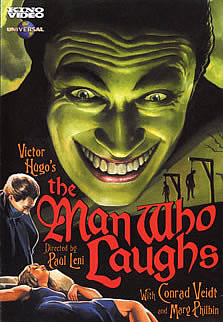
The Man Who Laughs (Universal, 1928), featuring Conrad Veidt, Mary Philbin, Olga Baclanova, and Cesare Gravina. Directed by Paul Leni. Production supervised by Paul Kohner. Silent film with synchronized Movietone soundtrack. Re-released on DVD and VHS by Kino Video in conjunction with Universal Pictures, October 2003 (110 min.)
Available from:
US:
The Kino Video standard definition DVD version is now out of print. You can order it from Amazon.com, 
UK and Europe:
There are two recent PAL editions that are available on standard definition DVD. One is a Spanish release Region 2 PAL version that appears to be from the same restoration as the Kino edition; the other is a French all-region PAL edition that may be from the domestic US print judging by its length. It is also available to rent or buy in the UK in standard defintion streaming format (also the same restoration as the Kino Video edition) from Amazon.co.uk Instant Video.
_____
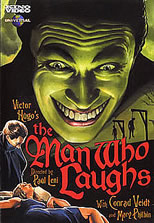 |
Olga Baclanova’s best-known and most-seen performance may be as the trapeze artist Cleopatra in Freaks, but her second-best known role is a far better performance and more representative of her abilities as an actress. That role is as the Duchess Josiana in The Man Who Laughs.
The Man Who Laughs stands as one of the most influential films of the silent era, but until recently this amazing film has only made itself known to the general populace by occasional screenings at film conventions and through the bootleg market due to copyright restrictions. Kino Video rectified this problem by releasing a beautiful new restoration of The Man Who Laughs on DVD in October of 2003 on special arrangement with Universal Pictures and with assistance from the Cineteca del Comune di Bologna, who conducted the restoration of the film using a sparkling 35mm foreign-release print. A year later, Sunrise Silents released a version transferred from a domestic-release print and added beautiful tints and tones. Thanks to the ingenuity of these two companies it is now possible to see the film again, and in two different versions at that.
Loosely based on Victor Hugo’s lesser-known novel L’Homme Qui Rit, Universal’s The Man Who Laughs set the prototype for the legendary Universal Horror films which were soon to follow. Although not itself a true horror film, The Man Who Laughs provided many of the genre’s elements: the bleak, Gothic settings; the creepy lighting techniques; the hard-hitting thrills combined with caricaturish humor; and the twisted, monstrous make-up of the main character. Many of these trademark elements were in turn lifted and developed from the German expressionist films of the early 1920’s, whom the film’s director, Paul Leni, was involved with personally as a director and, more importantly, as a set designer. This alone makes The Man Who Laughs a must-have item for all students and fans of the Universal Horror genre and of old horror films in general.
Plot Summary
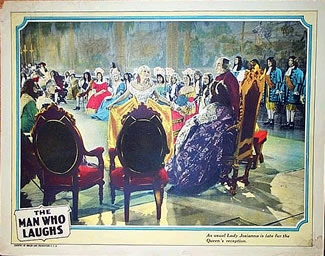 |
This original lobby card shows something of the large-scale investment that was put into The Man Who Laughs. The caption on the lower right reads, "As usual Lady Josiana is late for the Queen's reception." |
The story opens on a grim note in late 17th Century England, with His Majesty King James II sentencing rebel nobleman Lord Clancharlie to the Iron Lady, a brutal instrument of torture. Lord Clancharlie has come back to look for his young son, only to find that the King’s jester Barkilphedro has sold the boy to the Comprachicos, gypsy surgeons who mutilate young children and sell them as circus freaks. The Comprachicos carved a permanent grin on the boy’s face, so that regardless of what emotion he is feeling, his face is always fixed in a permanent grin, which makes everyone laugh when they see it.
This young boy grows up to be Gwynplaine, a strolling player and clown famous all over England as “The Laughing Man”. At a booking at London’s Southwark Fair, one of the old Comprachico surgeons spots Gwynplaine and, in an attempt at blackmail, leaks to higher sources that this laughing mountebank is the rightful heir to Lord Clancharlie’s estate. The plan backfires, as the English royalty kill the surgeon and arrest Gwynplaine, putting him in prison and then making him a peer in the House of Lords. They then plan to force him into a marriage with Duchess Josiana, the current heir to Lord Clancharlie’s estate, in order that she may continue to hold title to the estate. But Gwynplaine protests the forced marriage and runs away, escaping at the last minute on a ship to Holland with the Queen’s guards in hot pursuit...
About the Film
The Man Who Laughs was the latest in a succession of large-scale costume pictures with grotesque themes, which Universal had struck gold with earlier in the decade. The first of these successes was a filmed version of Victor Hugo’s The Hunchback of Notre Dame in 1923, and the second was of Gaston Le Roux’s The Phantom of the Opera in 1925. Both films feature Lon Chaney, Sr. in the grotesque starring role. Universal decided to continue the pattern, choosing The Man Who Laughs, another novel by Victor Hugo, as the subject of their next costume picture with a grotesque theme.
By the time the film was ready for production, Lon Chaney, who had been the starring grotesque for the previous two horror films, had left Universal for a contract with MGM, and was therefore unavailable for the starring role. This problem was quickly solved in German actor Conrad Veidt, whom John Barrymore had brought over from Germany to appear in his United Artists-released costume feature The Beloved Rogue (1927), and who was already under contract with Universal. Although the starring grotesque role in The Man Who Laughs is undeniably Chaney-like, the movie certainly did fine without him, as Conrad Veidt hammers the role home using his eyes and body language alone to express a myriad of emotions that his mouth is unable to express due to the transfixed grin. Universal was so happy with Veidt’s performance that they had already begun considering him for another grotesque role: that of Dracula in the soon-to-be-legendary 1931 film of the same name. But this was not to be, as Veidt returned to Germany in 1929, concerned that his heavy German accent would not qualify him for top roles in American sound films.
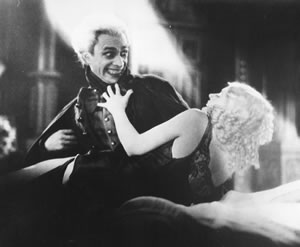 |
The Duchess Josiana (played by Olga Baclanova) vamps Gwynplaine (Conrad Veidt) in a still frame from The Man Who Laughs. |
Olga Baclanova plays the role of Duchess Josiana, a spoiled, debauched heiress who tries to lure Gwynplaine into a rendezvous until she learns that she must marry him in order to keep her fortune, upon which she immediately throws him away. Conrad Veidt was aware of Olga's international renown and her current availability in Hollywood and specifically requested her for this role. Olga plays the perfect slut in this picture, a woman whose low-minded, self-centered attitude is much more at home in the Mardi Gras-like atmosphere of the Southwark Fair than in the royal courts. She looks ever annoyed and unconcerned with the prim and proper etiquette of Queen Anne’s court, even though she can easily play the game of putting on airs. Her real excitement is in gossiping and partying, in seducing men and being ogled by them, and in watching ruffians tear each other apart over her.
Olga's perceived sluttiness exudes from the picture so strongly that one would not guess the real-life Olga Baclanova to be anything but the hussy she is playing in the picture. One would also suspect that off the set she would not have cared one bit for lead actor Conrad Veidt, judging from the way she heartlessly disposes of him in the picture. And yet Olga revealed quite the opposite sentiment when author John Kobal interviewed her later in her life, telling him, “Conrad Veidt was wonderful. I was crazy about him!” This speaks strongly of what a good actress Olga Baclanova was and could be with the proper direction, as does her similarly convincing performance as a dejected wife who murders her husband in Josef von Sternberg's The Docks of New York (1928), a performance many critics considered to be her finest hour.
Two of the other actors in The Man Who Laughs were alumni from former Universal director Erich von Stroheim’s productions with the company. Although Universal had fired Stroheim five years before for using up too much of the studio’s financial resources for his pictures, the studio kept some of the actors that he had brought to the studio, including Mary Philbin and Cesare Gravina. Mary Philbin had successfully played Agnes Urban in Stroheim’s production The Merry-Go-Round (1923) and the opera singer Christine in The Phantom of the Opera, and was therefore an obvious choice for the sympathetic role of Dea, the beautiful blind girl who performs in Gwynplaine’s show and who loves Gwynplaine regardless of his grotesque appearance. Italian-born Cesare Gravina plays Ursus, the writer and philosopher who manages Gwynplaine’s show and plays adopted father to both Gwynplaine and Dea. Gravina had played minor roles in The Merry-Go-Round and The Phantom of the Opera, as well as in Stroheim’s Foolish Wives (1921), but graduates here to a stronger supporting role.
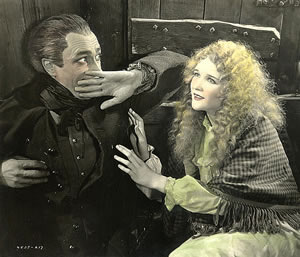 |
Mary Philbin plays Dea, the beautiful blind girl who loves Gwynplaine despite his disfigured face. |
But it was the people behind the scenes who would add the elements that would make The Man Who Laughs the influential picture that it is today. As mentioned earlier, Paul Leni had worked as a set designer and director in German expressionist films such as Backstairs (1921) and Waxworks (1924). When Universal brought him to America, he used the new and different American way of making pictures to his advantage, developing a marked style that combined elements of dark atmosphere, horror and humor, a pattern Universal would continue to use for many horror films to come. And beginning with The Man Who Laughs, Universal brought on make-up artist Jack Pierce, who created Gwynplaine’s death’s-dead grin. Pierce would forever leave his fingerprints on the Universal Horror genre by creating the make-up for most of the key Universal grotesques, including Frankenstein, The Mummy, The Wolf Man, The Invisible Man, and many, many more.
Universal began pre-production on The Man Who Laughs in May of 1927, and was well into the production of the film when an unforeseen event took place: Warner Bros.' The Jazz Singer, a part-talking film, became a tremendous overnight success in October of that year and began a rush of interest in talking pictures. When The Man Who Laughs premiered in New York on April 27, 1928, the interest in talking pictures was becoming insatiable. Universal did not want to lose their considerable investment in The Man Who Laughs, so they went to work creating a Movietone soundtrack for the film. After its New York premiere, the film received a limited first run as a roadshow attraction before its general release in July 6 as a silent film. It was then re-released with its completed soundtrack on November 4, 1928. Critical response was mostly favorable, and the film made a handsome profit for Universal.
About the Restored Kino Edition
 |
The Kino restoration of this picture is taken largely from a 35mm foreign release print from Milan, which is supplemented by a 16mm print from London. The use of this original 35mm print has resulted in a viewing experience that can be called nothing less than a revelation for those used to watching the movie from 16mm source material, which all domestic versions of the film derive from.
A short video presentation called “About the Restoration”, found amongst the extras on the DVD, reveals to a small degree the difficulty the restorers had in marrying the restored foreign-release print to the original Movietone soundtrack (which was impeccably restored and provided by Universal Studios). To save money on tariffs and overseas shipping, the studio would cut two negatives, one for the domestic market and one to be shipped overseas. The foreign negative would then be duplicated overseas and appropriately distributed. The domestic and foreign negatives would have the same cutting continuity, but would use different shots and different takes, winding up with slightly different editing rhythms. In restoring the film and preparing for its DVD release, the better-condition foreign print had to be conformed to the domestic soundtrack, which required nips and tucks and the occasional necessity of referring back to a 16mm domestic print to achieve the appropriate effect. Sometimes this is not a noticeable problem at all, but sometimes it does bring some jumps into the continuity of the picture.
For the long shots, the cameramen photographed the same action with two separate cameras. Therefore, the action looks the same in the two prints, except that they are from two slightly different camera angles. Most of the time, the two cameras would be side by side. But in a few of the medium shots, the cameras would be up and down from each other. The most noticeable of the latter type is at the beginning of Chapter Twelve, “The Show Must Go On”. Dea is seated and staring off into space. Ursus comes in, and after a long deliberation, Dea says, “It must be time for the performance.” In the foreign release, the shot is taken from the ceiling, looking down on the subjects. But in the domestic release, the shot is taken from the waist level, looking slightly up at the subjects, even though the action is completely the same.
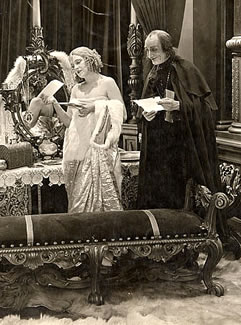 |
The Duchess Josiana, fresh from her bath, receives the blackmail letter from the Comprachico surgeon, delivered in person by the court jester. The bathing scene, though modest, is a little less modest in the foreign release version. |
In the close-up shots and some of the medium shots, separate takes are shot and used for each negative. Here, the shot sequence is exactly the same, but the content of the shots is obviously different. Sometimes the shots are so similar they are difficult to tell apart, but at other times there is a noticeable difference between the two. As one compares the domestic and foreign prints, it becomes obvious that the better and more fluid takes were kept for the domestic negative, and the second-best takes were used for the foreign release. This results in a slightly jumpy editing continuity for the foreign release, with moments of brilliance amongst moments that don’t work quite as well. Sometimes this even results in a completely different set of emotions being conveyed in the action. For instance, when Gwynplaine sneaks out at night to see the Duchess Josiana, Dea looks more suspicious, at one point slowly turning her head like a live mannequin when she hears the rustling of Gwynplaine leaving the van. In the domestic release, she hears the noise, but does not seem to suspect anything. Both are good, but this sequence in the foreign release comes across in a creepier and more suspenseful manner, but with a less fluid continuity, whereas the sequence in the domestic release is much cuter, uses Mary Philbin’s personality to better effect, and flows effortlessly.
Throughout the picture, Mary Philbin’s facial expressions tend to be more deadpan in the foreign release, but more full and expressive in the domestic. It’s quite possible that this was a calculated move, as Philbin received top billing in the domestic release, but Veidt received top billing in the foreign release. American audiences would expect a more vibrant personality for their star, while as a leading lady in Europe, Philbin would be expected to support Veidt.
Despite the long hours and hard work must have went into preparing this restored version, there are a several places where this restored version misses the mark altogether. The most conspicuous is the absence of a key shot in the boudoir scene in Chapter Ten, "A Private Audience". The original shot in the domestic release is a long, lingering shot of a lingerie-clad Josiana sprawled on her bed, which pans all the way down her body, stopping at her exposed legs for an elongated gaze. The Sunrise Silents version has this shot, and the same shot can also be seen on Kevin Brownlow’s TV documentary Universal Horror, which has been shown on Turner Classic Movies. But the corresponding shot in the Kino edition of the DVD begins with a close-up of Olga’s face, and then stops when the camera is only beginning to pan downward. Unfortunately, we lose some of the effect of Gwynplaine’s surprise and shock at seeing a ready-and-willing Josiana laid out before him, which this one shot single-handedly drives home. Another fouled-up shot occurs at the Southwark Fair, where a clown jumps in place and runs toward the camera with a Gwynplaine flyer. The original effect in the domestic release (which again, the Sunrise Silent version has) was for this to be one continuous shot, with the clown running toward the camera with the flyer and holding it there in front of the camera. But in this release, the clown almost gets to the camera when the film cuts to a shot taken from later in the film where hands are taking copies of the flyer, again missing the intended effect. But these are only minor flaws in a DVD release that is overall a vast improvement on every bootleg copy of this film that has been available up to this time.
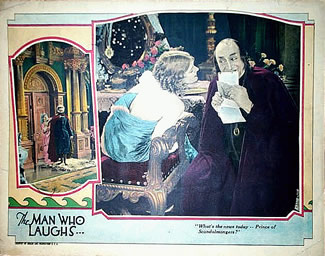 |
Another original lobby card. The caption reads, "What's the news today - - Prince of Scandalmongers?" The DVD release of The Man Who Laughs contains a gallery of similar promotional material from around the world to browse through. |
One painfully noticeable mastering flaw is the presence of numerous fine hairs wriggling at the bottom of the screen for nearly twenty minutes toward the end of the picture. One hair getting through is unsightly enough (David Shepherd’s Film Preservation Associates prints are notorious for this), but here it looks like they poured Miracle-Gro at the bottom of the screen! Apparently this mistake was made in the labs in Italy and Kino could do nothing about it, but it looks awful and should be fixed for future pressings.
The extras are plentiful and will give you plenty to look at after you’ve finished watching the picture. The crown jewel of these extras is a three-minute excerpt from the German documentary film Die Filmstadt Hollywood, which features a number of German stars and other foreign stars who were in Hollywood around the time The Man Who Laughs was released, including Conrad Veidt with his wife Felicitas and baby girl Viola, Greta Garbo, Camilla Horn, Dolores del Rio, and Emil Jannings with his wife Gussy (who, interestingly enough, was also Conrad Veidt’s ex-wife!). Also included is a documentary about the film, and an excerpt of the unedited Italian release print used for the restoration, which features some beautiful (and somewhat expressionistic) illustrated Italian-language title cards. It’s too bad that a full release of this Italian version is not yet available!
The rest of the extras on the Kino Edition will add some reading and browsing pleasure that will give you a little more insight into the film and the promotion surrounding it. A twenty-minute documentary offers many facts on the production of the film, and the booklet essay “An Introduction” features more facts not covered by the documentary. An excerpt from the end of the original novel by Victor Hugo reveals a sad ending to the story that is quite different from the happy ending in the film. The short video presentation “About the Restoration” briefly discusses the restoration of the film and gives a visual comparison of the different camera angles in the foreign release and the domestic release. This presentation also shows a visual comparison of Olga Baclanova’s nude bathing scene in the two versions. This bathing scene, although brief and quite modest, is not quite as modest in the foreign release, as the foreign release (and also the Kino version of the film) leaves in a few glimpses of nudity that the domestic release completely conceals. There is also a gallery of photographs from the film, including make-up tests, production photos, and a couple of stills from deleted scenes, as well as a gallery of promotional material and memorabilia connected to the film from seven different countries and in five different languages. These extras are well chosen and will definitely give depth and breadth to the viewing experience.
You will want to see The Man Who Laughs if you enjoy great silent films, if you are a fan of the Universal Horror genre, or just want to be thoroughly seduced by Olga Baclanova. This Kino Video edition has unfortunately gone out of print and has become hard to find; however, it is still available to rent on Netflix in the USA. Also check your local library for a copy, or ask for it on inter-library loan.