OLGA BACLANOVA
A biography by L. Paul Meienberg
Reprinted from Films of the Golden Age #24 (Spring 2001)
(some small edits made by David Gasten, May 2015)
 |
Time: Summer, 1943
The maroon Packard town sedan crested the last hill in Marin County and sped southward toward the Golden Gate Bridge. The mission at the moment was to deliver Mme. Baclanova on time for her matinee performance at the Geary Theatre in the long-running hit Claudia. Earlier that morning she had dallied with her brunch hosts in Marin County who on the spur of the moment had suggested a drive to Fort Ross, the remains of Imperial Russia's southern-most incursion into California. Olga was exuberant with the prospect of seeing the long abandoned outpost of her motherland, but with all sense of time and direction askew, the party made it only as far as the redwood grove of Muir Woods before the priority of the impending curtain-call took hold. Having played the role of Mme. Daruschka hundreds of times during the last two and a half years, on Broadway and then on tour throughout the country, Baclanova's enthusiasm never ebbed, especially when performing before a San Francisco audience which had thronged to see her in Grand Hotel on the same stage in 1932.
Her submersion in every role she undertook and the adulation of the audience could help numb her personal grief and concern for the welfare of her many family members in war-torn Europe. The phony wartime rapprochement between America and Russia made her ever more wary of her family's fate . . . and especially her first born son, now twenty years old, whom she had not seen since he was a toddler. Seventeen years before while on tour with the Moscow Art Theater, Baclanova's defection was branded by the Soviet regime as a sellout to the American dollar. She would always fear the revenge the regime would exact on the family of a "traitor." This preoccupation never left her, even as she alighted from the Packard as it pulled up to the curb outside the Geary Theatre. She reacted with a magnanimous smile and wave when several charmed passers-by greeted her. She then disappeared into the recesses of the theatre, entered her dressing room, and endured the expected several moments of reproach from her maid for yet another tardy arrival.
♥♥♥♥♥♥♥♥♥
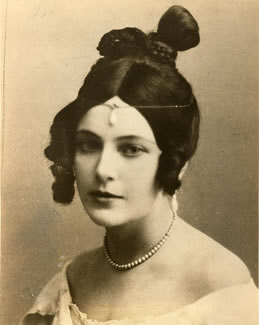 |
Olga in the title role of La Perichole (1920) at the Moscow Art Theatre Musical Studio in Russia. |
She was born Olga Vladimirovna Baclanova on August 19, 1893, in Moscow, Russia. Her parents, Vladimir Baclanoff and his wife Alexandra, had a strong interest in the arts. The family was wealthy and her mother, Alexandra, had given up her theatrical ambitions to marry and raise six children. After her father took Olga to a theater rehearsal at age ten, her love of the stage never wavered. Upon completion of her classical education at the Cherniavsky Institute in Moscow, Olga competed with 400 aspiring students for three openings at the Moscow Art Theatre. Despite stiff competition, she was accepted at the M.A.T. at the age of nineteen. During her apprenticeship she would often spend the summers in the Crimea, where unbeknownst to the directors of the M.A.T., Stanislavsky and Nemirovitch-Danchenko, many students including Olga were appearing, circa 1914, in one- or two-reeler films. Her films of this period may not be totally documented, but it seems that she starred or appeared in at least a dozen and a half films. One of her contemporaries at the M.A.T. and in films was Maria Ouspenskaya who was to arrive in the US in the early 1920s and open an acting school based on Stanislavsky's "Method Acting" concepts. Film makers from that period who often acted in their own productions included Michael Chekov and Richard Boleslawski, both of whom later came to Hollywood.
By 1917 Olga was appearing in the M.A.T. Parent Company Productions of works by Puskin, Chekov, Turgenev, and in the M.A.T. first studio productions of works by Shakespeare, Dickens and Berger. Though her career seemed well on its way, her family was not immune from the tragedy befalling her nation. During the upheaval of the fall of the Czar, her father was murdered, and the family was confined to one room of their mansion. Around this time, Olga made the decision to marry a lawyer named Vladlimir Zoppi for sake of convenience. It appears to have been a supportive union. She had previously made the first Soviet propaganda film titled Bread and knew her survival depended on her complicity with the New Regime's demands. Her mentor, Nemirovitch-Danchenko decided to form a new studio at M.A.T., the Musical Studio, which would present classical works with avant-garde staging. Between 1920 and 1925 Olga would be the jewel around which five large-scale productions were staged. To prepare for this she studied dance and voice with the great talents available at the M.A.T. About 1923/24 Olga had a son, and as soon as she was able, she prepared herself for what was to become the last production that she would appear in while still in Russia.
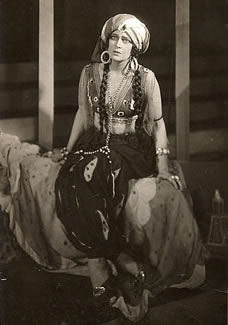 |
Olga in The Fountain of Bakhshi during the Mocow Art Theatre's 1925-26 American tour. |
In early 1925, Baclanova was given the highest award a Soviet artist could receive: "Worthy Artist of the Republic" and she was highly praised for her contributions. Several months into the 1925 season, the M.A.T. took their current production on a European tour and then on to New York in December. Much publicity surrounded her New York debut and also in the ensuing months during which the company presented their repertoire of past performances, all under the aegis of Morris Gest, the well-known impresario who had fostered the visit. It may have been Gest who encouraged Olga to stay in America in mid-1926 when the Musical Studio returned to Moscow. The political situation in Russia did not portend well. As the new regime consolidated its power and eliminated all opposition, artistic freedom was strangled. Soon the regime would turn against avant garde art and mire Russian culture in a stodgy conservatism.
Olga was soon to appear in the West Coast Company production of The Miracle, and while in Los Angeles agreed to accept an unbilled bit part in Norma Talmadge's The Dove, which was in production in 1927. She was noticed by Conrad Veidt, who asked for her to play the evil Duchess Josiana in The Man Who Laughs. This film was released twice in 1928, the second time with musical soundtrack in the fall of 1928. Meanwhile, Paramount cast her in Street of Sin at the apparent prompting of Emil Jannings. Joseph Von Sternberg, who wrote the story, later had to finish directing the film as the ailing Mauritz Stiller, Garbo's mentor, returned to Sweden and soon died. Fay Wray was cast opposite Jannings, but it was Baklanova (as Olga's name was still spelled) who stole the acting honors. Although she had been slated to appear with Jannings in Sins of the Fathers, the jealous Jannings would not stand to be upstaged again. The female lead would be played by the newcomer Ruth Chatterton. By the spring of 1928, Paramount offered Olga a five-year contract. About this time several years were subtracted from her age and a new spelling was given to Baclanova. The next few months would witness two of the finest Paramount films of the late silent period: von Sternberg's The Docks of New York, in which Olga magnificently portrayed a prostitute, and Forgotten Faces with William Powell. Also released in 1928 were Three Sinners, a Pola Negri vehicle; and Avalanche, a Zane Grey western with Jack Holt. (These last two films and the better-regarded Street of Sin are considered lost films.)
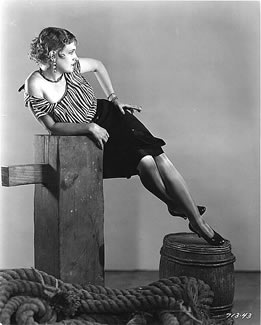 |
Critics considered Olga's role in Josef von Sternberg's The Docks of New York (1928) to be one of her finest performances. |
Paramount certainly was not on the cutting edge of the industry movement to rush into sound production. But when they did decide by mid-1928 to proceed, they made a decision to pair Baclanova again with George Bancroft (both having just appeared in The Docks of New York) in The Wolf of Wall Street. The production had potential for both stars. Meanwhile, a fire destroyed a newly constructed sound stage and the film had to be completed on a makeshift sound stage to meet a release date of January 1929. Any sound film at this time was a novelty, so the public's attendance was virtually guaranteed. The film did well. Olga sang "Love Take Heart" and spoke with an intriguing accent, which was often hard to understand. From now on Olga would by necessity be cast as a Russian or continental type.
What came next was a letdown: two poorly received films. Top-billed, Baclanova gave a campy performance in A Dangerous Woman as a man-hungry wife in a ludicrous story set in darkest Africa . . . old hat British colonial stuff! Then William Wellman's The Man I Love gave Baclanova an unsympathetic society tramp role with pugilist Richard Arlen as her momentary lover. Olga again sang in both films, but the style was one of concertizing.
Olga appeared in court in early 1929 to seek to annul her contract with her former manager, Al Rosen. She claims to have understood the contract was for one year and not five. The Los Angeles superior court ruled for a dismissal of the contract after concluding that her meager understanding of English and her failure to correctly interpret the contract substantiated her contention.
By the summer of 1929 Olga married her fiancé, Nicholas Soussanin, a Russian actor whose minor career dwindled from bits to uncredited parts over a fifteen-year period. She had finally received a divorce from her first husband in Russia in February. Summer also brought a new contract with Paramount, but no new roles were offered. Paramount sent her on a publicity tour: first at the Hollywood Bowl and then on to The Palace in New York. By November the studio dropped her option and she was released along with Esther Ralston.
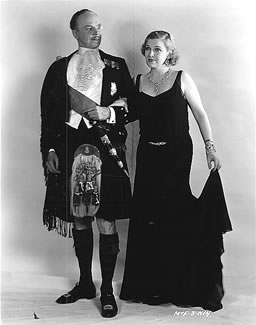 |
A visibly pregnant Olga in the Fox production Are You There? (1930). |
November 1929 brought a film offer from Herbert Wilcox to star in The Life of Beethoven in England. Olga and her husband sailed for England, but once there, the production closed down. After two months Olga returned to Hollywood with a new contract at Fox. She completed two musical comedies in which she portrayed the man-hungry femme fatale which solidified her image as the "Russian Tigress". Visibly pregnant to the discerning eye on the set of Are You There? (1930), she completed this bizarre Beatrice Lillie vehicle prior to the August birth of her son. For nearly one year Olga was off-screen and stayed at home.
When Baclanova returned to films in mid-1931 it was at MGM where her best produced films to date were made. The first one, The Great Lover, marks Irene Dunne's film singing debut. Olga played with distinction and considerable pathos, the cast-off lover of Adolphe Menjou. Her well-conceived portrayal of an aging opera singer was commended by critics.
At this point Olga returned to her first love, the stage. When she was interviewed by a movie magazine in 1928, she stated that she would make an effort in films, but only for five years before returning to her craft. In October 1931 she appeared opposite Branwell Fletcher in a West Coast production of Silent Witness, which had been a strong vehicle for Lionel Atwell on Broadway.
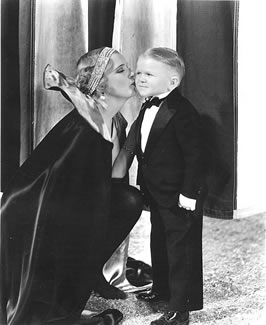 |
Olga as the villainess Cleopatra playing opposite the midget Harry Earles in Freaks (1932). |
By early November she received a call from MGM to report for filming of Freaks (1932). This rediscovered classic was reviled, discarded, disowned, and eventually reclaimed by MGM after its cult status had been firmly established by the early 1970s. Baclanova is remembered, if for nothing else in her long career, for her role of Cleopatra, the evil trapeze artist.
While she still had two more film commitments, Downstairs (1932) at MGM and Billion Dollar Scandal (1933) at Paramount, she appeared on the West Coast stage in 1932 in Grand Hotel, Twentieth Century, and The Cat and the Fiddle. In early 1933 she left Hollywood behind and headed for New York. She may have been legally separated from her husband at this time. He remained in Hollywood while she lived and performed in New York, London, and on tour across the US for the next six years. They divorced in 1935.
Olga had become an American citizen September 25, 1931. In May and June 1933 she appeared in $25 Per Hour; then the rather successful Earl Carroll's Murder at the Vanities. She left the latter in January 1934 and opened in a new show, Mahogony Hall, a rather dismal effort which soon closed. During 1935 and 1936 Olga appeared in two Vitaphone and one Mentone production two-reeler shorts, all of which were filmed in New York. In August 1936 she sailed aboard the "Ile De France" for London where she made her London debut in Going Places at the Savoy theatre on October 8,1936 in strong support to the star June Knight. Upon her return to America, she toured across the country in Idiot's Delight, Twentieth Century and Grand Hotel. In early 1938 she hosted a radio show, Olga Baclanova's Continental Review, on the Mutual Network for about two months. Olga was heard singing in New York's Russian Tea Room and various night clubs. In 1940, she prepared for her swan song, one which provided her several years of profitable employment. Claudia, Rose Franken's novel, adapted to the stage and then to the screen, offered a perfectly penned role for Olga in the character of Madame Daruschka, a flamboyant, worldly opera singer who cannot restrain herself from proffering unsolicited advice to child-bride Dorothy McGuire on the subject of sex appeal. The play was performed hundreds of times on Broadway. During the tour, Twentieth Century-Fox arranged for her temporary release so she could appear in the film version in 1943.
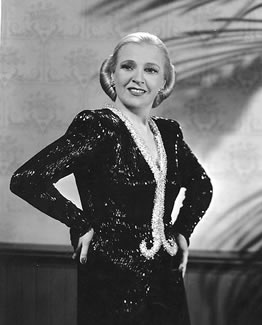 |
Olga in the stage production of Claudia (circa 1942). |
In 1937, Olga married Richard Davis, a Russian with an anglicized name, who owned the Fine Arts Theatre in New York. (Note: Davis' varied career also included editing Dance magazine, owning a publishing company, and importing foreign fims for the US market. Read more on Davis and his career at this link.) Davis encouraged Olga to retire, but she continued on for a few more seasons of Straw Hat summer stock. Finally in 1948 after leaving the cast of Louisiana Lady, which then went on to only four performances on Broadway, she retired. Or did she? There are reports that she appeared in a television episode of the Man Against Crime series in 1951. Nothing much was heard of Olga though she was a familiar figure in New York and occasionally could be glimpsed at her husband's theatre.
She traveled to Europe and once ran into her old nemesis Josef von Sternberg in Europe. She reminded him of how he had castigated her on the set of The Docks of New York for her inability to follow his direction over what he had said an untrained extra could have performed. After she broke down on the set from this humiliation, she went on to give the next take her very best, or what von Sternberg would like to believe was her pinnacle performance.
During the mid 1960s with the rediscovery of Freaks, Olga, long a legend, was sought out for interviews by Kevin Brownlow, John Kobal, and Richard Lamparski. She was charming and gracious, but much of her recollections often indicated her memory was eluding her. She eventually moved to Vevey, Switzerland, and after a period of declining health, she died at a rest home on September 6, 1974.
The stage was her first love and her career on the screen was decidedly a secondary, pragmatic consideration. In retrospect, her survival in talking films was a tribute to her talent, physical charm and presence, despite her often incomprehensible command of the English language. Her place in film history is secured by any one of several remarkable performances.